
Contents
Overview
The concept of drug resistance isn't new; its roots trace back to the earliest days of medicine. Even before the advent of modern antibiotics, observations hinted at variations in treatment success. For instance, early attempts to treat infections with chemical agents sometimes met with limited or transient efficacy, suggesting inherent resilience in some disease-causing agents. The post-World War II era saw an explosion in antibiotic development, but also a corresponding acceleration in the emergence of resistant strains, a pattern that has continued unabated.
⚙️ How It Works
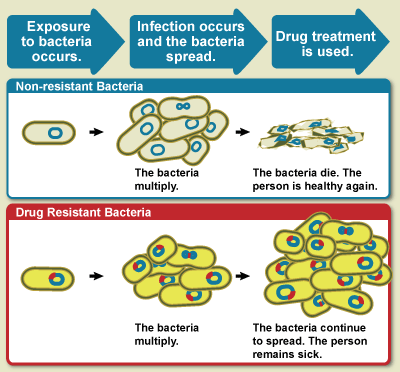
At its core, drug resistance is an evolutionary process driven by natural selection. When a drug is introduced, it exerts selective pressure on a population of pathogens or cancer cells. Those individuals with pre-existing genetic variations that confer even partial resistance are more likely to survive and reproduce, passing on their resistance genes. This can occur through various mechanisms: bacteria might alter the drug's target molecule, develop enzymes to degrade the drug, pump the drug out of their cells, or acquire new genes that confer resistance from other organisms, a process known as horizontal gene transfer. For cancers, resistance often arises from mutations within the tumor cells themselves, allowing them to evade chemotherapy or targeted therapies. The specificity of many drugs, like antibiotics targeting bacterial enzymes, makes them particularly vulnerable to mutations in those specific molecular pathways.
📊 Key Facts & Numbers
The scale of drug resistance is staggering. The rise of multidrug-resistant organisms (MDROs) renders once-effective treatments obsolete.
👥 Key People & Organizations
Numerous individuals and organizations have been pivotal in understanding and combating drug resistance. Pharmaceutical giants have historically been major players in drug discovery, though the pipeline for new antimicrobials has slowed significantly in recent decades, prompting calls for new economic models to incentivize development.
🌍 Cultural Impact & Influence
Drug resistance has permeated global culture, often appearing in fictional narratives and public health discourse. The specter of untreatable infections, popularized in science fiction and disaster films, reflects a deep-seated societal anxiety about losing our battle against microbes. The term "superbug" has entered the popular lexicon, evoking images of invincible pathogens. Public health campaigns, often featuring stark statistics and warnings, aim to educate the public about the responsible use of antibiotics, emphasizing that these drugs are not for viral infections like the common cold. The challenge of drug resistance has also influenced scientific research funding and policy debates, highlighting its status as a major global health security issue, akin to bioterrorism or pandemics.
⚡ Current State & Latest Developments
The current state of drug resistance is one of escalating crisis. This has led to a resurgence of interest in older, less-used drugs and novel approaches, such as phage therapy and CRISPR-based antimicrobials. In oncology, the development of resistance to targeted therapies and immunotherapies remains a significant hurdle, prompting research into combination therapies and adaptive treatment strategies. Global surveillance efforts are crucial for tracking the emergence and spread of resistant strains.
🤔 Controversies & Debates
The controversies surrounding drug resistance often center on the economic drivers of antibiotic development and the overuse of these critical medicines. Critics argue that the low profit margins for new antibiotics compared to drugs for chronic conditions disincentivize pharmaceutical companies from investing in their research and development, a phenomenon often referred to as the "market failure" in antibiotics. This has led to debates about alternative funding models, such as subscription-based reimbursement systems proposed by countries like the UK.
🔮 Future Outlook & Predictions
The future outlook for combating drug resistance is a race against time, but one with glimmers of innovation. Researchers are exploring entirely new therapeutic modalities, including antimicrobial peptides, nanoparticle-based drug delivery systems, and therapies that target bacterial virulence factors rather than killing the bacteria directly, which may exert less selective pressure for resistance. In cancer, advancements in liquid biopsies are showing promise for detecting resistance mutations earlier, allowing for more timely treatment adjustments. The development of AI-driven drug discovery platforms, such as those pioneered by companies like Exscientia, could accelerate the identification of novel drug candidates. However, without significant global policy changes, increased investment in R&D, and a drastic reduction in the overuse of existing drugs, the future could see a return to a pre-antibiotic era where common infections become deadly once again.
💡 Practical Applications
Drug resistance has profound practical implications across multiple sectors. In healthcare, it necessitates the development of rapid diagnostic tools to identify resistant pathogens and guide appropriate treatment, as well as infection control protocols to prevent their spread within hospitals and communities. The pharmaceutical industry is actively seeking new drug targets and therapeutic strategies, exploring everything from repurposed drugs to entirely novel molecular approaches. In agriculture, understanding resistance is crucial for optimizing antibiotic use in livestock to ensure food security while minimizing public health risks. Public health initiatives focus on education and stewardship programs to promote the judicious use of antimicrobials in both human and animal medicine. Even in environmental science, monitoring resistance genes in wastewater and soil provides insights into the broader dissemination of these genetic elements.
Key Facts
- Category
- science
- Type
- topic