
Contents
Overview
The concept of fracture, the breaking of materials, is as old as human civilization itself, evident in the earliest stone tools chipped by early hominins for survival. Ancient civilizations understood and exploited fracture properties, from the deliberate fracturing of obsidian for sharp blades by Aztec artisans to the construction of monumental structures like the Pyramids of Giza, which relied on the predictable fracture behavior of quarried stone. The formal scientific study began to coalesce in the late 19th and early 20th centuries with the development of continuum mechanics and the nascent understanding of material fatigue. Pioneers like Alan Turing (though not directly in fracture mechanics) laid groundwork in mathematical modeling, while engineers grappled with unexpected structural failures, such as the catastrophic collapse of the Tay Bridge in 1879, which spurred investigations into material stress and failure modes. The formalization of fracture mechanics as a distinct field truly took off in the 1940s and 1950s, driven by the urgent demands of World War II aviation, particularly the inexplicable cracking of de Havilland Mosquito aircraft fuselages and the Liberty ship failures, leading to the development of key theories by figures like George Irwin and Michael Polanyi.
⚙️ How It Works
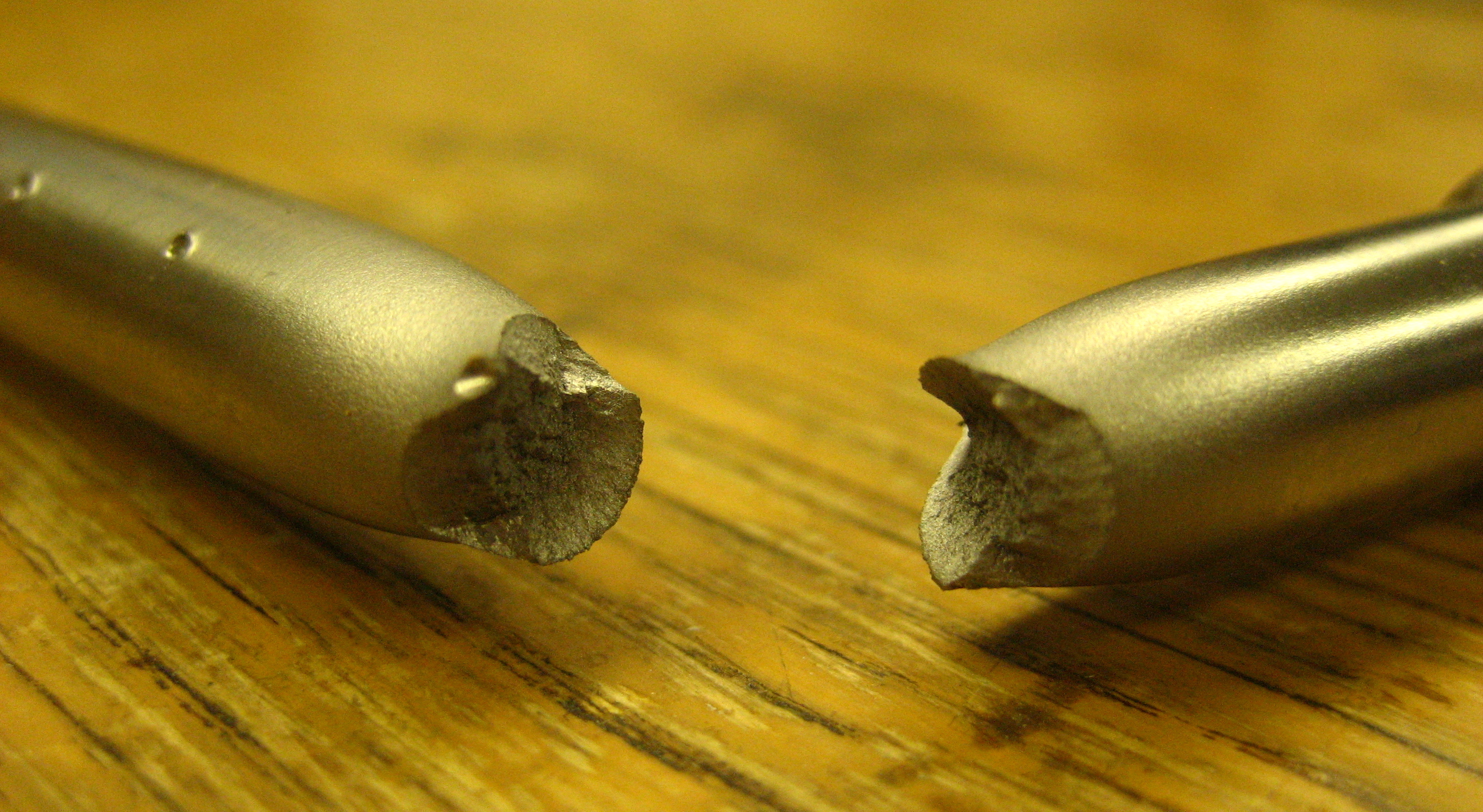
At its core, a fracture is the propagation of a discontinuity within a material. When stress is applied, it concentrates at microscopic flaws or defects, such as voids or grain boundaries. If the stress intensity at these points exceeds the material's fracture toughness, a crack begins to form. This crack then propagates through the material. In brittle fracture, this propagation is rapid and occurs with little to no plastic deformation, meaning the material doesn't visibly stretch or yield before breaking. Think of glass shattering. Ductile fracture, conversely, involves significant plastic deformation before and during crack propagation; the material visibly stretches and deforms, often forming a 'cup-and-cone' fracture surface in metals. The mechanism involves the movement of dislocations in crystalline materials or the breaking of molecular bonds in polymers and ceramics. The critical factor is the energy required to create new surfaces, a concept quantified by fracture mechanics through parameters like the stress intensity factor (K) and the J-integral.
📊 Key Facts & Numbers
The average human skeleton contains 206 bones, and it's estimated that over 1 million Americans experience a bone fracture each year, with hip fractures alone accounting for over 300,000 hospital admissions annually in the U.S. In materials science, the fracture toughness of steel can range from 20 to over 200 MPa√m, while that of brittle materials like glass is typically below 1 MPa√m. The catastrophic failure of the de Havilland Comet jetliner in the 1950s, attributed to metal fatigue and stress concentration around square windows, led to redesigns and highlighted the critical importance of understanding fatigue crack growth, which can occur after thousands of stress cycles below the material's yield strength. The global market for fracture analysis software was valued at approximately $700 million in 2023 and is projected to grow by 6% annually.
👥 Key People & Organizations
Key figures in the formalization of fracture mechanics include George Irwin, often called the 'father of fracture mechanics,' who developed the concept of stress intensity factor (K) in the 1940s, and James R. Rice, who developed the J-integral in the 1960s, a crucial tool for analyzing ductile fracture. Alan Neilson Kalan also made significant contributions to understanding fatigue. Organizations like the American Society of Mechanical Engineers (ASME) and the International Institute of Welding (IIW) play vital roles in developing codes and standards related to fracture prevention and assessment. In medicine, orthopedic surgeons like William Coleman Ellis and institutions such as the Mayo Clinic are at the forefront of treating and researching bone fractures, developing advanced surgical techniques and biomaterials.
🌍 Cultural Impact & Influence
Fractures permeate our cultural consciousness, often serving as potent metaphors for breakdown, weakness, or irreversible damage. The phrase 'a crack in the foundation' signifies impending ruin, while 'breaking the mold' implies radical innovation. In literature and film, the shattering of an object—a mirror, a vase, a window—frequently symbolizes a character's psychological fragmentation or the irreversible loss of innocence, as seen in the symbolic breaking of mirrors in Black Mirror episodes. The dramatic depiction of bone fractures in sports, like Kevin Ware's compound leg fracture during an NCAA basketball game in 2013, captures public attention and underscores the physical vulnerability of athletes. The very concept of a 'fractured society' or a 'fractured psyche' highlights how the idea of breaking into pieces resonates beyond the physical realm, influencing our understanding of social cohesion and mental well-being.
⚡ Current State & Latest Developments
Current research in fracture is pushing boundaries in several directions. Advanced computational modeling, including finite element analysis (FEA) and molecular dynamics simulations, allows for increasingly precise predictions of crack initiation and propagation under complex loading conditions. The development of novel materials with enhanced fracture toughness, such as graphene composites and metallic glasses, is a major focus. In medicine, advancements in 3D printing are enabling patient-specific implants and prosthetics designed to withstand physiological stresses, while new bone graft substitutes and stem cell therapies aim to accelerate healing and improve outcomes for complex fractures. The study of fatigue crack growth in aerospace alloys and additive manufactured components remains a critical area for ensuring structural integrity.
🤔 Controversies & Debates
One persistent debate revolves around the precise mechanisms of fracture initiation in amorphous materials like polymers and glasses, where the absence of a regular crystalline structure complicates traditional dislocation theory. Another area of contention is the prediction of fracture in composite materials, where the interplay of different constituent properties and interface debonding creates complex failure pathways. In medicine, the optimal treatment strategy for certain complex fractures, particularly those involving joints or significant comminution, remains a subject of ongoing clinical research and debate among orthopedic surgeons, weighing the benefits of surgical intervention against the risks of infection and long-term complications. The long-term effects of microfractures in high-performance athletes and the potential for early onset osteoarthritis are also subjects of active investigation.
🔮 Future Outlook & Predictions
The future of fracture research is increasingly focused on 'smart' materials that can self-heal or exhibit significantly enhanced damage tolerance. Researchers are exploring self-healing polymers and self-healing concrete that can autonomously repair microcracks, extending material lifespan and reducing maintenance costs. In aerospace and automotive engineering, the goal is to design components that are not only stronger but also more resilient to fatigue and impact, potentially through advanced additive manufacturing techniques that allow for optimized internal structures. For bone fractures, the trend is towards personalized regenerative medicine, using tissue engineering and nanotechnology to stimulate rapid and complete bone regeneration, minimizing the need for invasive surgeries and hardware. The development of predictive models that can forecast fracture risk with near-perfect accuracy in real-time for critical infrastructure like bridges and pipelines is also a long-term aspiration.
Key Facts
- Category
- science
- Type
- topic