
Contents
Overview
The theoretical underpinnings of quantum dots were explored as early as the 1970s by physicists like Alexei Ekimov and Louis Brus, who independently observed quantum confinement effects in semiconductor microcrystallites. Ekimov, working at the Vavilov State Optical Institute in Moscow, published his findings on color changes in glass doped with copper halides in 1981, demonstrating size-dependent optical properties. Simultaneously, Brus at Bell Labs was investigating colloidal semiconductor particles, publishing his seminal work on quantum confinement in cadmium sulfide (CdS) particles in 1983. The term 'quantum dot' itself gained traction in the late 1980s and early 1990s as researchers like Christopher Murray and Mikhail Gromov developed more controlled synthesis methods, particularly for cadmium selenide (CdSe) QDs, paving the way for their widespread study and application in fields ranging from solid-state physics to biotechnology.
⚙️ How It Works
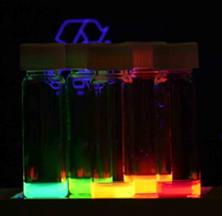
Quantum dots function by exploiting the quantum mechanical phenomenon of quantum confinement. When semiconductor material is reduced to nanoscale dimensions (typically 2-10 nm), the energy levels of electrons become discrete, similar to those in an atom, rather than forming continuous bands as in bulk materials. When a quantum dot absorbs a photon with energy greater than its band gap, an electron is excited to a higher energy state. As this electron relaxes back to its ground state, it emits a photon. Crucially, the energy of this emitted photon, and thus its color, is directly proportional to the size of the quantum dot. Smaller dots have larger band gaps and emit higher-energy, bluer light, while larger dots have smaller band gaps and emit lower-energy, redder light. This size-tunable photoluminescence is a hallmark of QDs, allowing for precise color control not achievable with conventional fluorophores or phosphors. The efficiency of this light emission, known as quantum yield, can also be exceptionally high, often exceeding 90% in well-passivated QDs.
📊 Key Facts & Numbers
The global quantum dot market was valued at approximately $1.5 billion in 2022 and is projected to surge past $10 billion by 2030, exhibiting a compound annual growth rate (CAGR) exceeding 20%. A typical QD display, like those found in Samsung's QLED TVs, can achieve over 100% of the Rec. 2020 color volume, a significant leap from the 70-80% typically seen in conventional LCD panels. In biomedical applications, QDs can offer up to 20 times greater brightness and 100 times longer photostability than traditional organic dyes, enabling more sensitive and prolonged imaging. The synthesis of QDs often involves precursor materials like cadmium telluride (CdTe) or indium phosphide (InP), with production costs for high-quality QDs sometimes reaching hundreds of dollars per gram, though mass production is driving these costs down. For instance, the first commercial QD-enhanced TVs were introduced by Vizio in 2015, followed by Sony and LG in subsequent years, marking a significant commercialization milestone.
👥 Key People & Organizations
Pioneering figures in QD research include Alexei Ekimov, who first demonstrated quantum confinement in semiconductor microcrystallites in glass in 1981, and Louis Brus, who independently explored quantum confinement in colloidal semiconductor particles at Bell Labs in the early 1980s. Christopher Murray, a key figure in developing scalable synthesis methods for colloidal QDs at MIT and later University of Pennsylvania, co-founded Nanocrystals Technology Inc. (later acquired by Apricity Technologies) in 1997, a significant early commercial venture. Sunghyun Kim and Taekyung Kim at Samsung Electronics have been instrumental in integrating QDs into commercial display technologies, particularly through their work on QLED displays. Major corporations like Dow Chemical, Nichia Corporation, and Nanoco Technologies are also significant players, investing heavily in QD material development and manufacturing.
🌍 Cultural Impact & Influence
Quantum dots have profoundly impacted the display industry, enabling brighter, more vibrant colors and higher contrast ratios in televisions and monitors, most notably through QLED technology pioneered by Samsung Electronics. Beyond consumer electronics, their exceptional photostability and tunable emission have made them indispensable tools in biological and medical research, facilitating advanced fluorescence microscopy, targeted drug delivery, and sensitive diagnostic assays. The ability to precisely control their emission spectrum has also opened doors for novel lighting solutions, promising more energy-efficient and color-accurate illumination. Furthermore, QDs are being explored for applications in solar energy conversion, quantum computing, and even security features, demonstrating their broad cultural and technological resonance. Their integration into everyday devices like smartphones and TVs has brought the once-esoteric field of nanotechnology into the mainstream consumer experience.
⚡ Current State & Latest Developments
The current landscape of quantum dot technology is characterized by rapid advancements in material synthesis and application development. Companies like Nanoco Technologies are pushing for cadmium-free QD alternatives, such as indium phosphide (InP) and copper indium gallium selenide (CIGS) QDs, to address environmental concerns. In the display sector, the focus is on improving QD efficiency, reducing manufacturing costs, and integrating QDs more seamlessly into existing display architectures, moving beyond simple color filters to more direct emission methods. The development of perovskite quantum dots is also a significant trend, offering potentially higher efficiencies and lower production costs, though stability remains a challenge. Research continues into QD-based LED lighting for improved color rendering and energy efficiency, as well as their use in next-generation photovoltaic cells and biosensors.
🤔 Controversies & Debates
A primary controversy surrounding quantum dots centers on the use of heavy metals, particularly cadmium, in their composition. Cadmium is a toxic element, and while QDs are typically encapsulated, concerns persist regarding potential environmental leakage during manufacturing, product disposal, and recycling. This has spurred significant research into cadmium-free alternatives, such as indium phosphide (InP) and copper indium gallium selenide (CIGS) QDs, though these often face challenges in achieving the same level of performance and stability as their cadmium-based counterparts. Another debate revolves around the long-term stability and degradation of QDs, especially under harsh operating conditions or prolonged light exposure, which can affect device lifespan and performance. The patent landscape for QD technology is also complex and highly contested, with numerous companies holding patents and engaging in licensing disputes, impacting market access and innovation.
🔮 Future Outlook & Predictions
The future of quantum dots appears exceptionally bright, with ongoing research poised to unlock even more transformative applications. Expect to see QDs integrated into flexible and transparent displays, enabling novel form factors for electronic devices. Advancements in perovskite quantum dots could lead to even more cost-effective and efficient displays and lighting solutions, potentially challenging OLED technology. In the biomedical field, QDs are likely to become standard tools for in vivo imaging and targeted therapies, offering unprecedented diagnostic cap
💡 Practical Applications
Quantum dots have found diverse practical applications, most notably in display technology where QLED displays utilize them to produce exceptionally vibrant and accurate colors. Their unique optical properties also make them valuable in advanced lighting systems, offering improved color rendering and energy efficiency. In the realm of diagnostics and biomedical imaging, QDs serve as highly sensitive fluorescent labels, enabling researchers to visualize cellular structures and processes with greater clarity and for longer durations. They are also being explored for their potential in solar energy harvesting, aiming to improve the efficiency of photovoltaic cells, and in the development of next-generation biosensors.
Key Facts
- Category
- science
- Type
- topic