
Contents
Overview
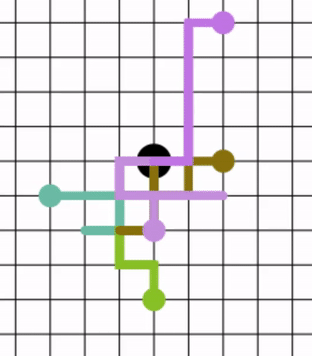
A random walk is a mathematical model describing a path composed of a sequence of random steps. Imagine a drunkard stumbling home, or a molecule bouncing around in a gas – each movement is independent and unpredictable. This concept underpins phenomena from the diffusion of particles in physics and chemistry to the fluctuations of stock prices in finance and the foraging patterns of animals in ecology. While seemingly simple, the aggregate behavior of random walks can exhibit complex emergent properties, making them a foundational tool in fields as diverse as statistical mechanics, computer science algorithms, and even social network analysis. Understanding random walks is key to modeling systems where chance dictates the trajectory.
🎵 Origins & History
The conceptual seeds of the random walk were sown long before its formal christening. Early observations of erratic movement in various contexts hinted at underlying random processes. However, it was Karl Pearson who coined the term 'random walk' to describe a sequence of independent, random steps. He proposed it as a model for phenomena like the path of a drunkard or the distribution of children's birthplaces relative to their parents. This initial framing, rooted in statistical physics and probability, laid the groundwork for its later expansion into diverse scientific disciplines.
⚙️ How It Works
At its core, a random walk is defined by a sequence of random variables, where each step is independent of the previous ones. More complex versions can occur in higher dimensions, with varying step sizes, probabilities, or even correlated steps. The path taken is a realization of this stochastic process, meaning each walk is unique, yet the ensemble of all possible walks shares predictable statistical properties.
📊 Key Facts & Numbers
Current research in random walks is pushing boundaries in several directions. Scientists are developing more sophisticated models to capture real-world complexities, such as biased random walks in heterogeneous environments or self-avoiding walks that cannot revisit previously occupied sites. Applications in machine learning, particularly in areas like graph neural networks, are leveraging random walk principles for tasks like node classification and exploration. The study of anomalous diffusion is a hotbed of activity, with implications for understanding transport in biological tissues and porous media.
👥 Key People & Organizations
A significant debate revolves around the applicability of the pure random walk model to real-world phenomena. Critics argue that many systems, particularly financial markets, are not perfectly random and exhibit patterns, trends, or 'fat tails' (extreme events occurring more frequently than a normal distribution predicts). The assumption of independent steps is also challenged in biological systems where memory or environmental feedback can influence movement. Furthermore, the computational cost of simulating very long or high-dimensional random walks can be substantial, leading to ongoing research in efficient simulation techniques and analytical approximations.
🌍 Cultural Impact & Influence
The future of random walk research appears robust, driven by increasing computational power and the demand for models that can capture complex, emergent behaviors. Expect to see more integration with AI for predictive modeling and anomaly detection. Applications in materials science, particularly in understanding diffusion and phase transitions, will likely expand. Furthermore, the use of random walks in designing new algorithms for network analysis, cybersecurity, and even drug discovery is poised for significant growth. The challenge will be to develop models that are both statistically rigorous and practically applicable to increasingly complex systems.
⚡ Current State & Latest Developments
Random walks are indispensable tools across numerous fields. In physics, they model diffusion and thermodynamics. In computer science, they form the basis for algorithms like Markov Chain Monte Carlo (MCMC) methods for statistical inference. In finance, they inform portfolio management and risk assessment. Biologists use them to study animal migration and cell motility, while ecologists employ them to model population dynamics. Even in social sciences, they can model the spread of information or opinions through networks.
🤔 Controversies & Debates
To truly grasp the power of random walks, one must explore the related concepts of stochastic processes and probability theory. Understanding Brownian motion is crucial for appreciating their physical origins, while Markov chains offer a generalized framework. For computational applications, delving into Monte Carlo methods is essential. Further reading on statistical mechanics and time series analysis will illuminate their broader scientific context.
Key Facts
- Category
- science
- Type
- concept