
Contents
- 🎵 Origins & History
- ⚙️ How It Works
- 📊 Key Facts & Numbers
- 👥 Key People & Organizations
- 🌍 Cultural Impact & Influence
- ⚡ Current State & Latest Developments
- 🤔 Controversies & Debates
- 🔮 Future Outlook & Predictions
- 💡 Practical Applications
- 📚 Related Topics & Deeper Reading
- Frequently Asked Questions
- References
- Related Topics
Overview
The conceptual roots of targeted cancer therapy stretch back to the early 20th century, with Paul Ehrlich's pioneering work on 'magic bullets'—compounds designed to selectively kill pathogens without harming the host. This vision, articulated around 1906, laid the groundwork for the idea of specific molecular targeting. However, it wasn't until the late 20th century that the necessary scientific understanding and technological capabilities converged to make this a reality for cancer treatment. The identification of specific oncogenes, such as the human epidermal growth factor receptor 2 (HER2) gene in breast cancer, and the subsequent development of monoclonal antibodies like trastuzumab in the 1990s, marked a pivotal moment. The approval of imatinib (Gleevec) by the U.S. Food and Drug Administration in 2001 for chronic myeloid leukemia (CML) further solidified targeted therapy's place, demonstrating remarkable efficacy by inhibiting the BCR-ABL fusion protein. This era saw the transition from broad-spectrum cytotoxic agents to highly specific molecular interventions.
⚙️ How It Works
Targeted cancer therapies operate by interfering with specific molecules that are essential for cancer cell growth, progression, and spread. These targets are typically proteins or genes that are altered or overexpressed in cancer cells compared to normal cells. One major class involves small molecule inhibitors, which are drugs small enough to enter cells and block the activity of specific enzymes or signaling pathways, such as tyrosine kinases that drive cell proliferation. Another significant class is monoclonal antibodies, which are proteins designed to bind to specific targets on the surface of cancer cells, either blocking growth signals, marking the cells for destruction by the immune system, or delivering toxic payloads directly to the tumor. Antibody-drug conjugates (ADCs) represent a hybrid approach, linking a monoclonal antibody to a potent chemotherapy drug, ensuring the toxin is delivered precisely to cancer cells. PARP inhibitors are another example, targeting DNA repair mechanisms that cancer cells rely on more heavily than normal cells.
📊 Key Facts & Numbers
The global targeted cancer therapy market was valued at approximately $150 billion in 2022 and is projected to reach over $300 billion by 2030, exhibiting a compound annual growth rate (CAGR) of around 9%. In the United States, approximately 50% of cancer patients receive some form of targeted therapy, a figure that has steadily increased since the early 2000s. For instance, HER2-positive breast cancers now see response rates exceeding 70% with targeted agents like trastuzumab and pertuzumab. The development pipeline is robust, with over 1,000 targeted therapy clinical trials underway globally as of 2023. The average cost of a targeted therapy drug can range from $10,000 to $20,000 per month, with some exceeding $50,000 annually, contributing significantly to healthcare expenditures.
👥 Key People & Organizations
Several key individuals and organizations have been instrumental in the advancement of targeted cancer therapy. Brian Druker, an oncologist at Oregon Health & Science University, was a leading figure in the development of imatinib (Gleevec), a breakthrough drug for CML. Dennis Slamon, a professor at UCLA, played a crucial role in the development of trastuzumab (Herceptin) for HER2-positive breast cancer. Major pharmaceutical companies like Novartis (developer of Gleevec), Genentech (a member of the Roche Group, developer of Herceptin), Pfizer (developer of crizotinib for ALK-positive lung cancer), and AstraZeneca (developer of osimertinib for EGFR-mutated lung cancer) are at the forefront of research, development, and commercialization. The National Cancer Institute (NCI) in the U.S. and the European Medicines Agency (EMA) are critical regulatory bodies approving these novel treatments.
🌍 Cultural Impact & Influence
Targeted cancer therapy has profoundly reshaped patient and physician expectations for cancer treatment, moving away from the 'one-size-fits-all' approach of traditional chemotherapy. The ability to personalize treatment based on a tumor's specific genetic mutations has led to improved survival rates and quality of life for many patients, particularly those with certain types of lung cancer, breast cancer, and melanoma. This success has fostered a greater public awareness of cancer genomics and the potential for precision medicine. The narrative around cancer treatment has shifted from enduring harsh side effects to a more hopeful outlook focused on specific, manageable interventions. However, this progress also brings challenges, including the need for sophisticated diagnostic tools and the ethical considerations surrounding access to expensive, life-extending therapies.
⚡ Current State & Latest Developments
The current landscape of targeted cancer therapy is characterized by rapid innovation and expanding applications. In 2024, new KRAS inhibitors are gaining traction for previously 'undruggable' mutations in colorectal cancer and pancreatic cancer. The field of antibody-drug conjugates (ADCs) is exploding, with several new ADCs receiving approvals for various solid tumors and hematological malignancies, including drugs like trastuzumab deruxtecan (Enhertu). Liquid biopsy technologies are becoming increasingly sophisticated, enabling non-invasive monitoring of treatment response and detection of resistance mechanisms, such as EGFR mutations in lung cancer. Furthermore, research is intensifying into overcoming acquired resistance, a common challenge where cancer cells evolve to evade targeted drugs, often through the development of bypass signaling pathways or new mutations.
🤔 Controversies & Debates
Significant controversies surround targeted cancer therapy, primarily concerning cost and access. The high price tags of these drugs, often exceeding $100,000 per year of treatment, raise serious equity concerns, creating a divide between those who can afford them and those who cannot. This has led to debates about healthcare policy, insurance coverage, and the pharmaceutical industry's pricing practices. Another area of contention is the development of acquired resistance, where cancers that initially respond to targeted therapies eventually stop doing so. Understanding and overcoming this resistance is a major scientific challenge, with ongoing debates about the optimal timing and combination of therapies to prevent or manage it. Ethical considerations also arise regarding the use of germline genetic testing and the implications for family members.
🔮 Future Outlook & Predictions
The future of targeted cancer therapy is increasingly focused on multi-drug combinations and even more precise personalization. Researchers are exploring rational combinations of targeted agents, or combining targeted therapies with immunotherapies, to achieve synergistic effects and overcome resistance. The integration of artificial intelligence and machine learning is expected to accelerate drug discovery, identify novel targets, and predict patient responses more accurately. We will likely see a greater emphasis on liquid biopsies for real-time treatment monitoring and adaptive therapy adjustments. Furthermore, the development of therapies targeting rarer mutations and neoantigens, potentially through cancer vaccines, is on the horizon. By 2030, it's anticipated that a majority of cancer patients will have their tumors genetically profiled to guide treatment decisions, making targeted therapy the standard of care for many cancers.
💡 Practical Applications
Targeted cancer therapies have direct practical applications in clinical oncology, forming the backbone of treatment for numerous cancer types. For patients with non-small cell lung cancer harboring specific EGFR mutations, drugs like osimertinib offer significantly improved outcomes compared to chemotherapy. In melanoma, BRAF inhibitors such as vemurafenib and dabrafenib are used for patients with the BRAF V600E mutation. For HER2-positive breast cancer, trastuzumab and pertuzumab are standard treatments. Beyond direct treatment, these therapies are crucial tools in clinical trials designed to test new hypotheses about cancer biology and drug efficacy. The development of companion diagnostics, tests that identify the specific molecular targets a patient's tumor possesses, is a critical practical application that ensures these therapies are used appropriately.
Key Facts
- Year
- 1990s-Present
- Origin
- Global (conceptualized in Germany, developed and advanced worldwide)
- Category
- science
- Type
- technology
Frequently Asked Questions
How is targeted therapy different from chemotherapy?
Targeted therapy focuses on specific molecular changes (like mutations or protein overexpression) that drive cancer cell growth, while traditional chemotherapy broadly attacks all rapidly dividing cells, including healthy ones. This specificity means targeted therapies often have fewer severe side effects than chemotherapy, such as hair loss or extreme nausea, although they can still cause significant side effects. For example, imatinib targets the BCR-ABL protein in CML, whereas cisplatin, a chemotherapy drug, damages DNA in all dividing cells.
What are the main types of targeted cancer therapies?
The primary types include small molecule inhibitors, which enter cells to block specific enzymes or signaling pathways (e.g., tyrosine kinase inhibitors like erlotinib for EGFR-mutated lung cancer), and monoclonal antibodies, which bind to targets on the cell surface (e.g., trastuzumab for HER2-positive breast cancer). Antibody-drug conjugates (ADCs) combine antibodies with cytotoxic drugs for precise delivery. Other categories include PARP inhibitors and angiogenesis inhibitors.
Why do targeted therapies sometimes stop working?
Cancers are dynamic and can evolve, leading to acquired resistance. This often happens when cancer cells develop new mutations that bypass the targeted pathway, overexpress the target molecule to overwhelm the drug, or activate alternative signaling routes. For instance, a mutation in the EGFR gene that initially responds to osimertinib might later develop a secondary mutation, like T790M, rendering the drug less effective. Understanding these resistance mechanisms is crucial for developing subsequent treatment strategies.
How are targeted therapies chosen for a patient?
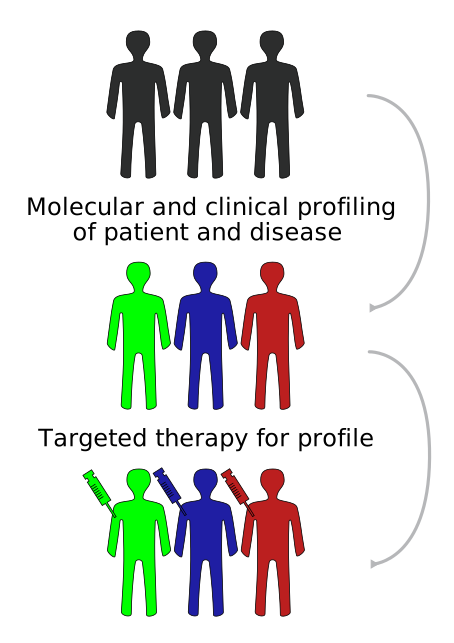
The selection of a targeted therapy is typically based on a detailed molecular profiling of the patient's tumor, often through genomic sequencing or biomarker testing. These tests identify specific genetic mutations, protein levels, or other molecular characteristics that the targeted drug is designed to inhibit. For example, a patient with non-small cell lung cancer will undergo testing for mutations in genes like EGFR, ALK, and ROS1 to determine if a specific targeted therapy is appropriate. This process is a cornerstone of precision medicine.
Are targeted therapies always more effective than chemotherapy?
Not necessarily. Targeted therapies are highly effective when a patient's tumor possesses the specific molecular target the drug is designed for. In such cases, they can offer superior efficacy and fewer side effects. However, if a tumor lacks the target, or if resistance develops, chemotherapy might still be the most effective option. Often, targeted therapies are used in combination with chemotherapy or immunotherapy to achieve better outcomes. The choice depends on the specific cancer type, its molecular profile, and the patient's overall health.
What are the biggest challenges in developing new targeted cancer therapies?
Key challenges include identifying novel, 'druggable' molecular targets, as many cancer-driving mutations are difficult to inhibit directly. Another major hurdle is overcoming acquired resistance, as cancers are adept at evolving to evade treatment. The high cost and lengthy duration of clinical trials, coupled with the need for sophisticated diagnostic tests (companion diagnostics), also present significant obstacles. Furthermore, ensuring equitable access to these often expensive therapies remains a global challenge.
What does the future hold for targeted cancer therapy?
The future points towards even greater personalization, with more sophisticated genomic sequencing and liquid biopsy techniques guiding treatment. We anticipate more combination therapies, integrating targeted agents with immunotherapies and epigenetic therapies. AI will play a larger role in identifying new targets and predicting treatment responses. The development of therapies for rarer mutations and the proactive management of resistance are also key areas of focus, aiming to make targeted therapy a viable option for a wider range of cancers and patients.